The risk level of a breed is calculated based on the number of male and female animals registered in studbooks nationwide, from which the effective population size (Ne) is determined.
To this end, the BLE (Federal Office for Agriculture and Food) conducts an annual population monitoring of all farm animal breeds bred in Germany. The data is obtained partly from the relevant umbrella organizations for animal breeding and partly directly from the individual breeding associations.
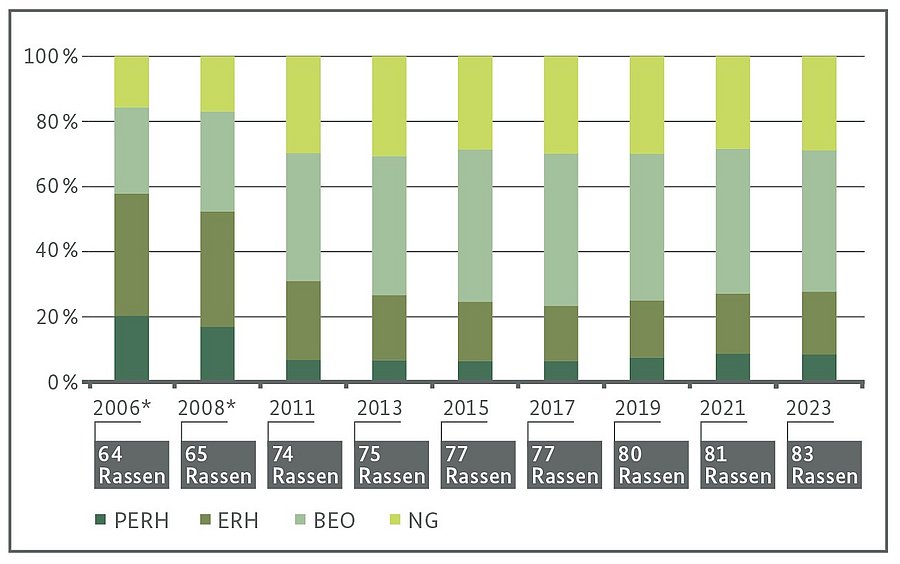
Based on population figures, the Federal Office for Agriculture and Food (BLE) and the Advisory Board on Animal Genetic Resources classify native livestock breeds into risk categories every two years.
The classification of native livestock breeds into one of the four risk categories is primarily based on the calculated Effective Population Size (Ne). This is calculated using the herd book data published in TGRDEU, according to the following formula:
4 x Number of male animals x number of female animals
Ne = -----------------------------------------------------------------------------
(Number of male animals + number of female animals)
However, in exceptional circumstances, a farm animal breed may also be classified in a different risk category.
Not at risk (NG):
- Effective population size: over 1,000
- Possible exceptions: If the risk assessment indicates a higher risk category, classification as NG may be considered if the new or synthetic breed is not yet consolidated through breeding and can be reactivated at any time from existing parent breeds, the breed is not maintained in its own studbook and its transfer to a separate studbook is not intended, the establishment of a cryoreserve is not currently necessary, or the breed is so widespread globally that no threat is foreseeable.
- Measures: successful use in agriculture, no conservation measures required, monitoring
Observation population (BEO):
- Effective population size: between 200 and 1,000
- Possible exceptions: If the Ne value indicates a higher threat category, classification as BEO may be considered if the population is stable and an effective breeding program is in place to maintain genetic diversity. If the Ne value indicates a higher threat category (NG), classification as BEO may be considered if the breed's distribution is only regional, the breeder structure is problematic, or the dynamics of population decline indicate a potential threat.
- Measures: Deep-freeze storage of semen is required, monitoring is necessary.
Conservation population (CPM):
- Effective population size: under 200
- Possible exceptions: If the Ne rating indicates a lower threat category, classification as ERH (Endangered Species of Danger) may be considered if the breed's distribution is limited to local areas, the breeding structure is highly problematic, or the dynamics of population decline indicate a significant threat potential.
- Measures: Deep-freeze storage of semen and conservation breeding programs are required, as is monitoring.
führt.
Phenotypic Conservation Population (PERH):
- Breeds of regional cultural significance where the animal population cannot be clearly traced genealogically back to the original breed, where the breed was already heavily mixed with other breeds when it was re-established, or where it had only dwindled to a very small number of animals, or where the breed had only very small population sizes over several generations.
- From an animal breeding perspective, these breeds can only be considered remnants.
- Monitoring is being carried out.