The main content of this page starts here
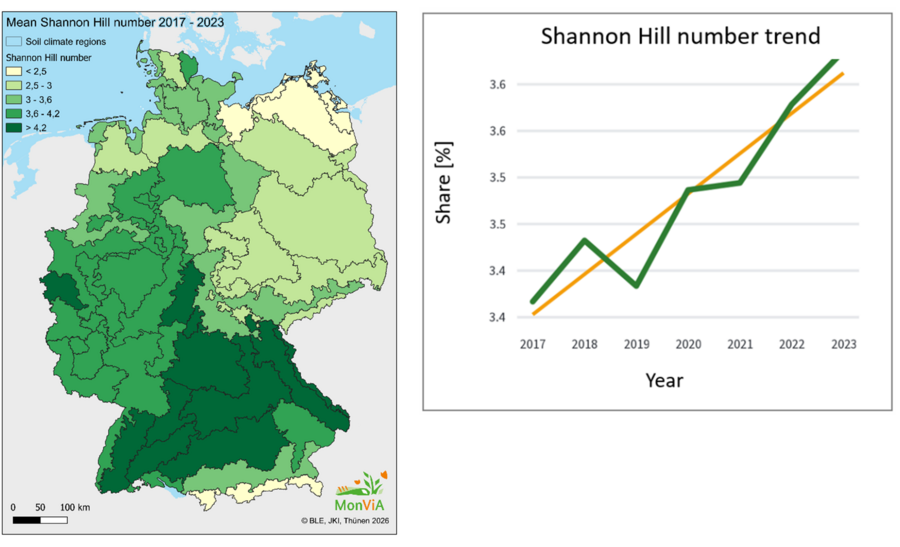
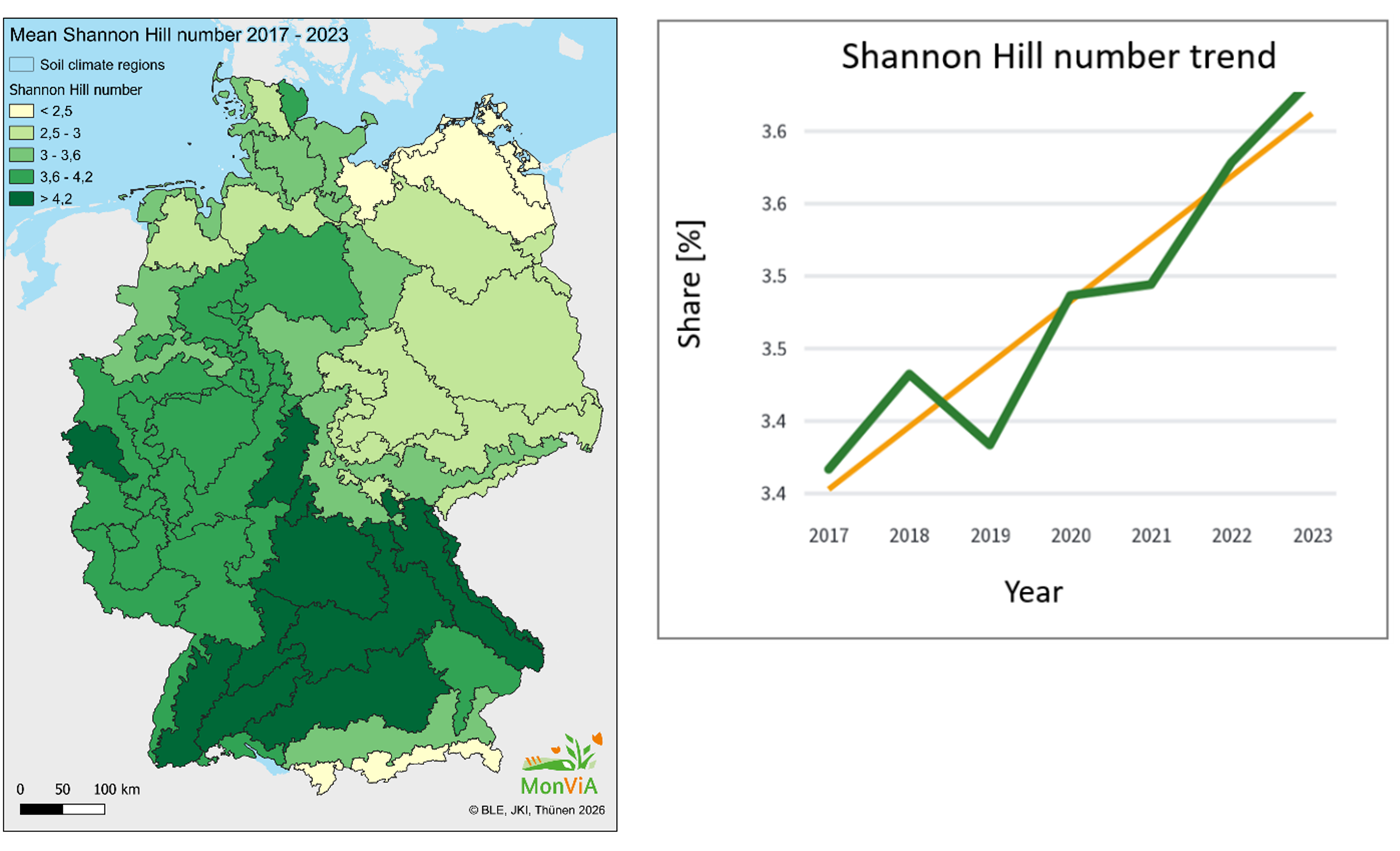
The indicator describes the diversity of crop types on arable land. The calculation is based on the Shannon-Wiener index (H), which takes into account both the number and the occurrence (area shares) of the main crop types within a landscape section. The result is presented as the Shannon element count (or ‘effective number of classes’ or ‘Hill number’), with higher values generally indicating greater habitat diversity (in this case: crop diversity). The Shannon Index is generally sensitive to classes with moderately high area proportions and is suitable for quantifying complex land use patterns. It should be noted that higher index values indicate more diverse land use, but do not necessarily imply greater biodiversity, as qualitative characteristics (e.g., the value of individual land use classes) are not taken into account. The indicator is based on a 7-year time series (currently 2017–2023) with national spatial coverage.
Last updated: 2026 (Based on Indicator Sheet v2025_1)